Geography
Leader: Mr Lumsdon
INTENT
Our Geography curriculum is designed to:
- Increase children’s knowledge and understanding of their own locality, the E.U. and contrasting localities in the wider world, which will help them set local, national and international events within a global context.
- Develop an awareness and understanding of features, physical processes and change in their immediate environment and other localities which they study.
- Enable children to understand and compare the physical and human characteristics and processes e.g. weather, settlement, transport and employment in different localities.
- Enable children to appreciate and compare the environment and to understand how and why people seek to manage and sustain environments and to identify ways in which damage can be repaired.
- Develop the skills, knowledge and understanding necessary to identify and investigate important cultural, social and environmental issues with sensitivity to people’s attitudes and values.
- Help children to develop an understanding of the nature of multi-cultural and multi-ethical societies and a sensitivity to cultural and racial prejudice and injustice.
- Develop competency in using maps, atlases, photographs, fieldwork techniques and to develop skills appropriate to geographical enquiry e.g. the ability to observe, analyse and communicate, to gather and interpret information and use ICT to support their learning where appropriate.
IMPLEMENTATION
The objectives of geography teaching in our school are based on the requirements of the National Curriculum programmes of study for EYFS, Key Stage 1 and Key Stage 2. We follow the aims of the Early Learning Goals for our EYFS curriculum, and we have followed advice from the Geographical Association when creating our KS1 and KS2 curriculum. Each topic has been designed specifically to fit with our school's vision, values and local context.
In terms of our EYFS geography curriculum, we focus on the section of the ELG that is ‘Understanding the World,’ and we use these objectives to inform the activities we deliver and offer to our EYFS children.
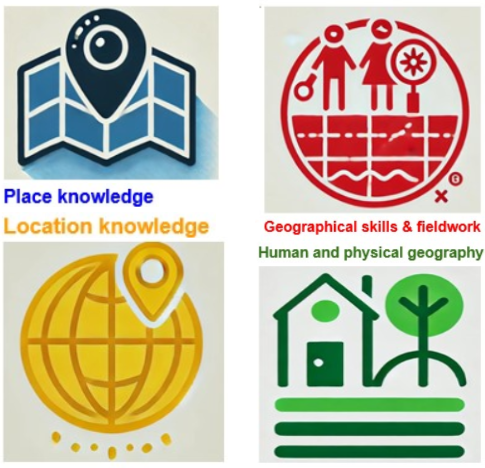
Our curriculum is split into key strands, based on the wording of the National Curriculum, and these form the foundations of our planning:
Pupils should be taught to:
Locational knowledge
~Name and locate the world’s seven continents and five oceans
~Name, locate and identify characteristics of the four countries and capital cities of the United Kingdom and its surrounding seas
Place knowledge
~Understand geographical similarities and differences through studying the human and physical geography of a small area of the United Kingdom, and of a small area in a contrasting non-European country
Human and physical geography
~Identify seasonal and daily weather patterns in the United Kingdom and the location of hot and cold areas of the world in relation to the Equator and the North and South Poles
~Use basic geographical vocabulary to refer to:
~Key physical features, including: beach, cliff, coast, forest, hill, mountain, sea, ocean, river, soil, valley, vegetation, season and weather
~Key human features, including: city, town, village, factory, farm, house, office, port, harbour and shop
Geographical skills and fieldwork
~Use world maps, atlases and globes to identify the United Kingdom and its countries, as well as the countries, continents and oceans studied at this key stage
~Use simple compass directions (North, South, East and West) and locational and directional language [for example, near and far; left and right], to describe the location of features and routes on a map
Where appropriate, we also utilise our membership to Mozaik3D. This allows us to bring abstract concepts and learning to life:
https://www.mozaweb.com/en/Extra-3D_scenes-Terms_of_physical_geography-139713
We have also incorporated the LYFTA platform into our weekly assemblies. This is an interactive resource which allows children to visit different locations and countries around the world and find out about the lives of people that live and work there.